Con Report: How to Spot a Shill Swap Meet Before Your Money Leaves Your Wallet

Let's look under the hood of the spring circuit.
March through May is active season for swap meets, regional shows, and the smaller cons that don't make headlines but move serious inventory. Local vintage gaming expos, flea market circuit pop-ups, regional retro gaming conventions—they run throughout this window in most metro areas. That means collectors are carrying cash, FOMO is running high, and the fraud operations that target exactly this environment are already set up.
I've been doing this long enough to have watched a Chrono Trigger CIB get auctioned three times at three different shows in a six-week span. Different seller each time. Escalating opening bid each time. Same artifact. That's not coincidence—or at minimum, it's a pattern worth naming.
Here's what I've learned to watch for before my wallet leaves my jacket.
The Three-Person Dance
In my experience, shill bidding at small shows follows a recognizable structure once you know what you're looking at. The most common version I've seen runs three roles: the seller, the walker, and the phone.
The seller runs the table. The walker circulates—they're browsing like everyone else, but buying nothing. They'll pick up items, turn them over, set them down. Their apparent function is to generate interest optics. What I've noticed: they never actually negotiate. They ask the price and walk away. That's a signal, not a customer.
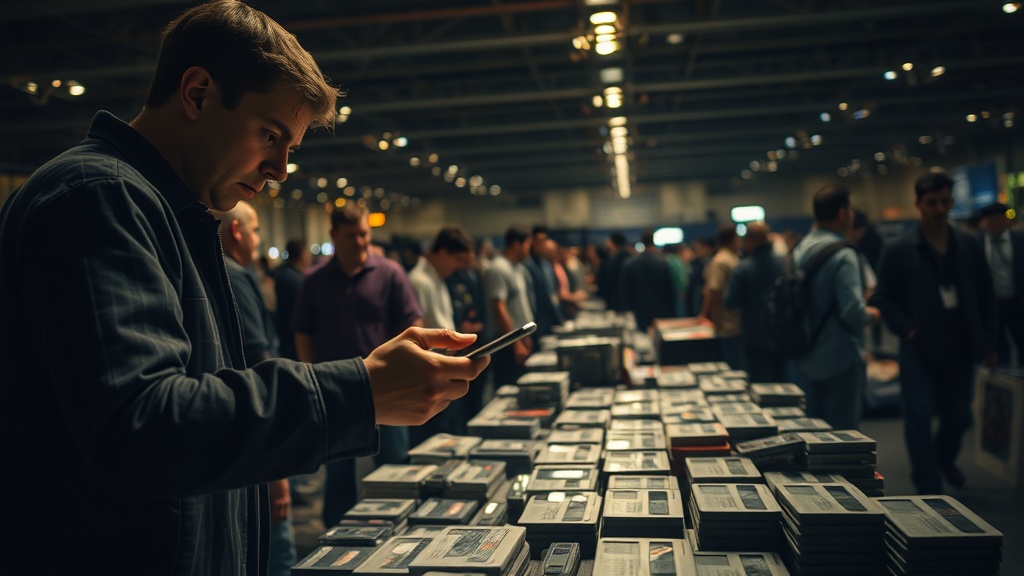
The phone is the tell that matters. When serious inventory hits the table—when someone like you or me picks up something and asks for a number—watch for the phone check. Not a casual pocket reach. A deliberate unlock, a glance, a lock back. That's someone on comms. There may be a third party receiving a real-time signal to come apply counter-pressure.
The counter-pressure, when it's coming, typically arrives within two to four minutes. Another "buyer" materializes, expresses interest in the exact item you're holding, and suddenly the seller has competition to point at. The price you're negotiating against is now anchored to a ghost.
Counter-move: when you pick up an item, don't negotiate immediately. Set it down. Walk two tables away. Watch what happens to the people around the seller's table. If the energy resets too deliberately—if the walker circles back and the phone comes out again when you return—you've got something worth paying attention to.
The Price Memory Fraud
The same artifact appearing at multiple shows with an escalating opening bid is one of the oldest plays in regional dealer fraud. It works because most collectors don't track cross-show prices systematically. We're at one show, we see one price, we make a decision. The seller is counting on that isolation. Understanding regional market valuation shifts helps you spot when pricing stops making sense.
Here's the version I've seen run: a piece—let's say a CIB copy of EarthBound with questionable box condition—gets introduced at a regional show with an $800 opening number. Nobody bites at $800. The seller "reluctantly" walks it back to $650. Still no sale, or maybe a fake partial negotiation with the walker. Item leaves the show unsold.
Six weeks later, the same item or a comparable-condition equivalent shows up at a different show. Opening bid: $900. The seller now has a story—"had an offer at $800 but turned it down, condition's better than it looks." The $800 floor has become the psychological anchor. The $900 price has legitimacy by comparison.
This is where invoice forgery can enter. Collector community threads have documented instances of fake purchase receipts circulating to establish artificial provenance—"Bought from an estate sale in 2018 for $400." The invoice looks legitimate because it's printed on plausible letterhead. These are easy to generate and harder to disprove on the spot.
Cross-convention price tracking is your defense. Before you show up anywhere with cash, spend twenty minutes in the collector Discord channels and the major Facebook vintage gaming groups running a search on whatever you're hunting. If the same item description has appeared in multiple threads with escalating prices, the community has memory even when individual collectors don't.
The Condition Lie—Thirty Seconds to Identify It
The refreshed label trick. This one makes me genuinely angry because it erodes authentication confidence across the whole market.
Labels get swapped or "refreshed" using heat application to smooth out creases and restore surface gloss. Here's how to identify it in under thirty seconds:
The gloss test. Authentic cartridge labels have a matte-to-satin finish that varies by manufacturer and era. A heat-gun-refreshed label often has a subtly uniform gloss—slightly too even, slightly too smooth across the entire surface. Run your eye across it at a low angle in raking light. Authentic aging creates micro-variance. Refresh tends to create uniformity. Not conclusive on its own, but a fast first screen.
The crease pattern. Original label damage—shelf wear, ring marks, corner lifts—follows use logic. A cartridge stored spine-up in a case gets corner wear. One stored spine-down gets edge wear. Refreshed labels can have the wrong wear distribution for their supposed provenance, or no wear in places that should have it. Look at the crease pattern and ask whether it makes sense for how someone would have stored this.
The weight difference. Subtle—and requires calibrating against enough authentic copies of the same title to mean anything—but a label swap adds a thin layer of adhesive and new substrate. This is a confirmation check, not a primary tell.
The CIB box swap tell. Boxes get sourced separately from loose cartridges and manual-matched to create artificial CIBs. The tell is in the aging consistency. Box, manual, and cart should show equivalent shelf time. A cart with legitimate oxidation matched with a box that looks like it came out of a climate-controlled closet is a red flag. Age should be consistent across all three components.
Set-Up Dealer vs. Working Dealer
Neither is automatically trustworthy, but they present different problems and you should know which one you're dealing with.
The set-up dealer is transient. They appeared at this show with a specific inventory and may not be at the next one. Their table is heavy on high-value singles. They don't have a card. They don't have a website. They're cash-only and they'll tell you the card reader "isn't working today." They have no accountability infrastructure because they've avoided building any.
Cash-only with no receipt is a strong red flag. A working dealer—someone running a legitimate operation—has real incentive to issue a receipt because they want repeat customers and they want dispute resolution documented. When someone declines to provide written documentation of a sale, that's worth noting.
The working dealer has a storefront, online presence, or at minimum a verifiable show history. They're not necessarily honest—they can price aggressively, misgrade condition, or push WATA-graded plastic coffins on you with full sincerity. But they have accountability. You can find them after the show. You can dispute. Their reputation is a real thing they protect.
Prefer the working dealer even when you distrust them, because you have leverage. With the set-up dealer, you have considerably less.
The Network Check: Before You Open Your Wallet
The Discord authentication channels and Facebook vintage gaming groups aren't just for showing off your finds. They're your background check system.
Here's the pre-show protocol I run on any dealer I'm planning to spend significant money with:
eBay history triangulation. Many dealers who do shows also sell online. Run their name, handle, or any shop name you can find through eBay sold listings. Look at condition grades versus actual sale photos. Do they consistently grade generous? Do they photograph in ways that obscure condition tells? Building a condition assessment protocol before you enter the dealer network is how you stay sharp.
The one Discord question that surfaces real information. Go into a cartridge authentication channel and ask a specific question: "Anyone have experience with [dealer name/handle] at [show]?" Don't ask if they're legit. Don't ask for a rating. Ask for experience. That phrasing invites stories rather than endorsements, and the community will tell you things that a direct legitimacy question won't surface.
Cross-reference against Facebook vintage gaming groups. These groups have long memories. Search the dealer's name and look at posts going back two or three years. If someone got burned, they typically posted about it. If the dealer has defended themselves, read both sides.
Regional community intelligence. The smaller the show, the more likely the regular attendees know the local dealer network. If you can connect with longtime local collectors before you arrive, ask specifically about transient dealers who appear at the show seasonally. The regulars tend to know exactly who shows up with cash-heavy inventory in the spring and disappears by summer.
The Floor Never Lies
Every fraud in this list works because it exploits collector urgency—the FOMO of a show environment, the social pressure of artificial competition, the emotional pull of a piece you've been hunting for. The floor is designed to accelerate your decision-making and shorten your verification window.
The counter is deliberate deceleration. You don't have to decide now. A legitimate deal rarely evaporates because you took fifteen minutes to run a name through Discord. Any seller who applies heavy time pressure to a high-value transaction is telling you something about their confidence in scrutiny.
Spring circuit is here. The authentic artifacts are out there. So are the operations that traffic in reproductions, refreshed labels, and coordinated bidding fraud. Walk slow. Check the board. Trust the crease pattern.
Happy hunting, but watch the set-up.